> ## Documentation Index
> Fetch the complete documentation index at: https://docs.request.network/llms.txt
> Use this file to discover all available pages before exploring further.
# Lifecycle of a Request
> The typical lifecycle of a request is as follows:
 ## Create a request
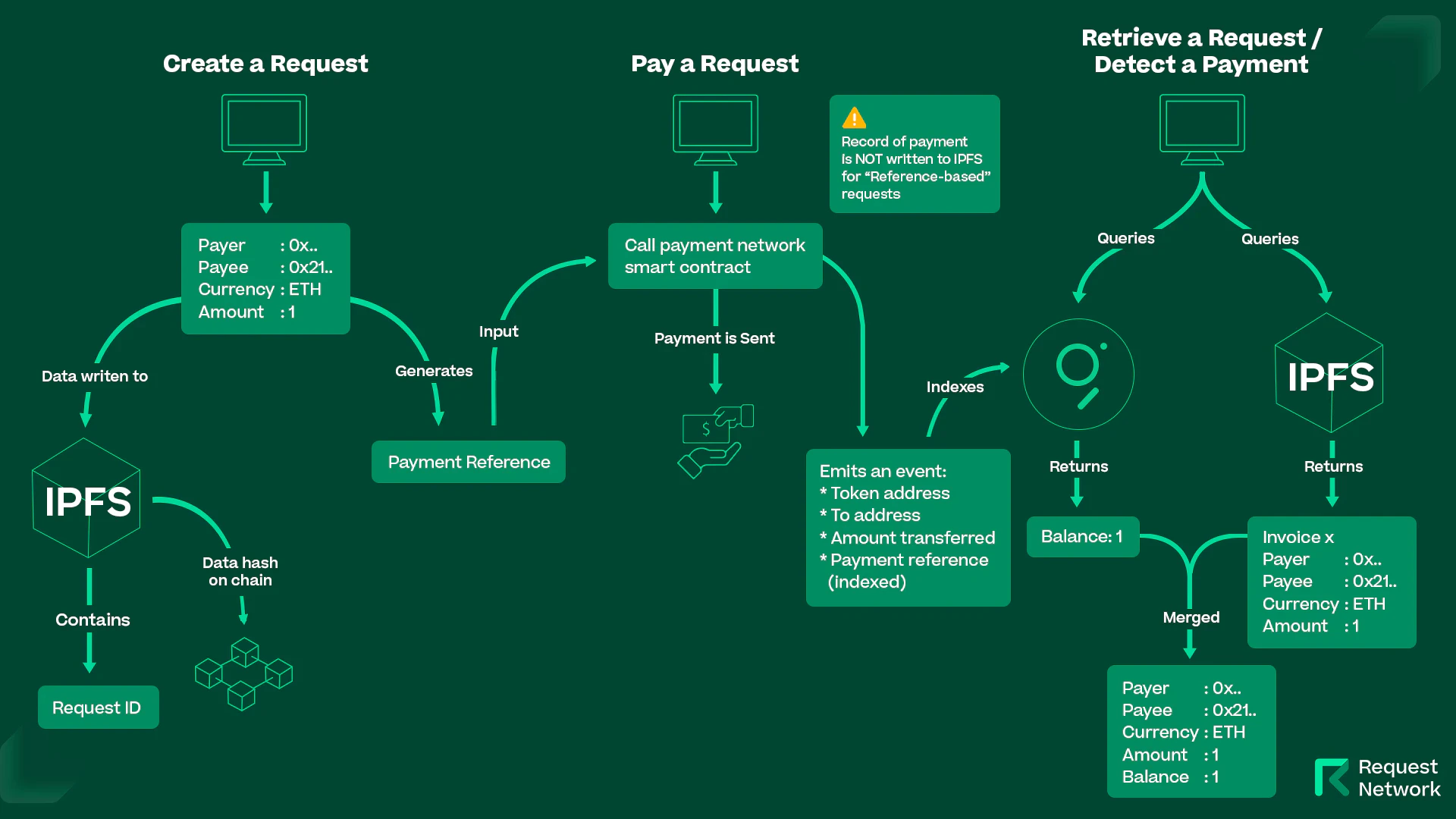
* The payer or payee signs the request which contains the payee, payer, currency, amount, payment details, and arbitrary content data.
* The request can be optionally encrypted such that only the payee, payer, and approved 3rd parties can view the request contents.
* The request is persisted in IPFS.
* The IPFS Content-addressable ID (CID) is stored in a smart contract on Gnosis chain
Requests are *created* by storing their CIDs on Gnosis, but this doesn't mean *payment* must occur on Gnosis. *Payment* can occur on any of the supported chains — EVM-compatible chains and Tron.
## Update a request
* The payee can optionally cancel the request or increase/decrease the expected amount.
* The payer can optionally accept the request, indicating that they intend to pay it.
* Both payee and payer can add third-party stakeholders if the request is encrypted.
## Pay a request
* The payer derives a paymentReference from the request contents.
* The payer calls a function on the payment network smart contract, passing in the token address, to address, amount, and paymentReference.
* An event is emitted containing the token address, to address, amount, and paymentReference.
Most requests are "reference-based" meaning that a paymentReference derived from the request contents is logged on-chain via a smart contract that emits an event. Nothing gets written back to IPFS when paying a "reference-based" request.
The exception is when paying a "declarative" request, in which case, data *is* written back to IPFS. This includes when the payer declares that the payment was sent and the payee declares that the payment was received.
## Retrieve a request / Detect a payment
* The event is indexed by the payments subgraph
* An app can retrieve the request contents from IPFS and calculate the balance based on events from the payments subgraph.
The request balance is calculated by adding up all the on-chain payment events with the same paymentReference. Partial payments are possible.
All of these steps are facilitated by the Request Network API. See the [Quickstart](/use-cases/quickstart) for the end-to-end flow.
## Create a request
* The payer or payee signs the request which contains the payee, payer, currency, amount, payment details, and arbitrary content data.
* The request can be optionally encrypted such that only the payee, payer, and approved 3rd parties can view the request contents.
* The request is persisted in IPFS.
* The IPFS Content-addressable ID (CID) is stored in a smart contract on Gnosis chain
Requests are *created* by storing their CIDs on Gnosis, but this doesn't mean *payment* must occur on Gnosis. *Payment* can occur on any of the supported chains — EVM-compatible chains and Tron.
## Update a request
* The payee can optionally cancel the request or increase/decrease the expected amount.
* The payer can optionally accept the request, indicating that they intend to pay it.
* Both payee and payer can add third-party stakeholders if the request is encrypted.
## Pay a request
* The payer derives a paymentReference from the request contents.
* The payer calls a function on the payment network smart contract, passing in the token address, to address, amount, and paymentReference.
* An event is emitted containing the token address, to address, amount, and paymentReference.
Most requests are "reference-based" meaning that a paymentReference derived from the request contents is logged on-chain via a smart contract that emits an event. Nothing gets written back to IPFS when paying a "reference-based" request.
The exception is when paying a "declarative" request, in which case, data *is* written back to IPFS. This includes when the payer declares that the payment was sent and the payee declares that the payment was received.
## Retrieve a request / Detect a payment
* The event is indexed by the payments subgraph
* An app can retrieve the request contents from IPFS and calculate the balance based on events from the payments subgraph.
The request balance is calculated by adding up all the on-chain payment events with the same paymentReference. Partial payments are possible.
All of these steps are facilitated by the Request Network API. See the [Quickstart](/use-cases/quickstart) for the end-to-end flow.